
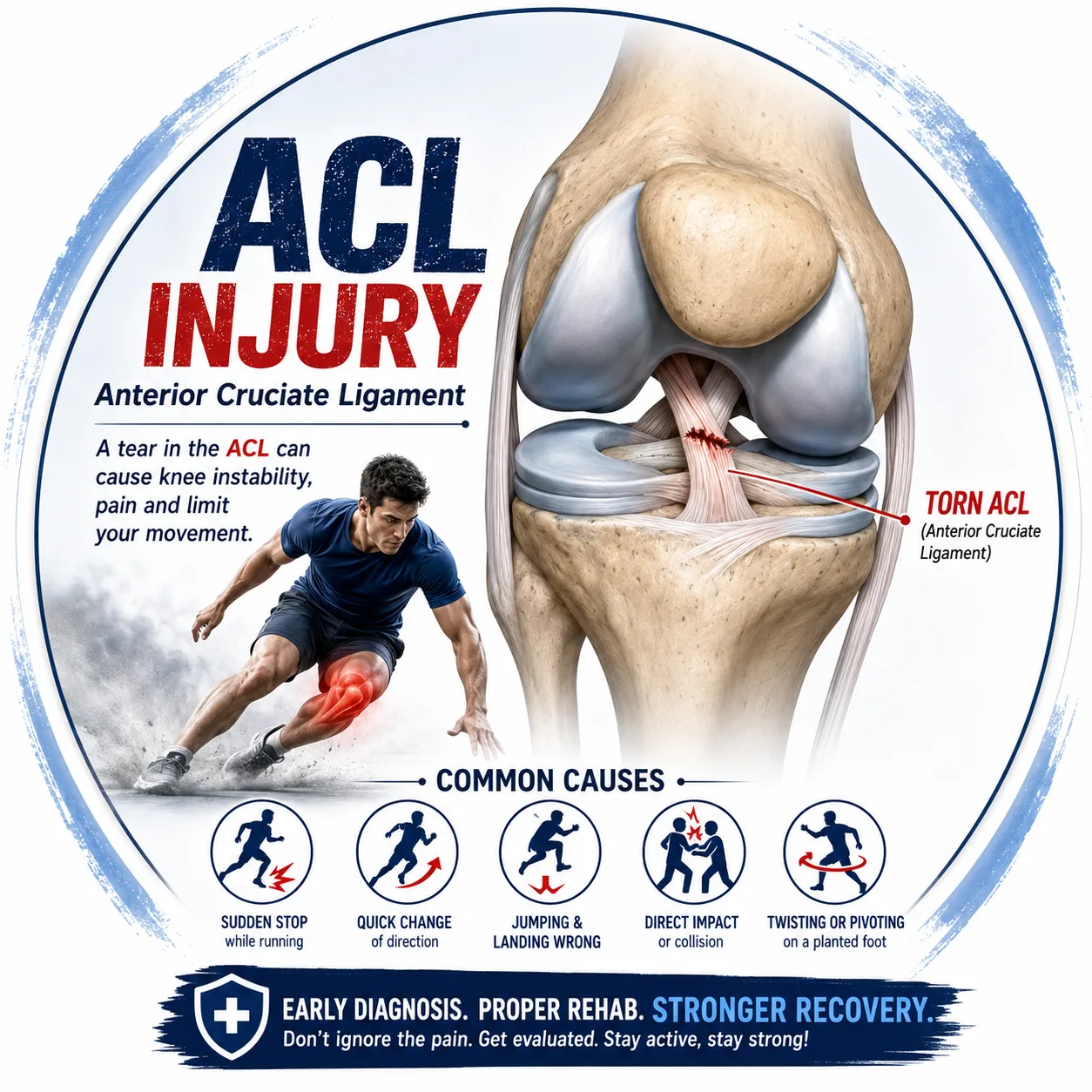
The ACL is located inside the knee and helps control the forward movement and rotation of the tibia relative to the femur. When the ACL is injured, the knee may become painful, swollen, weak, or unstable.
The good news is that structured rehabilitation can help restore knee movement, strength, balance, confidence, and functional ability. Treatment may involve rehabilitation alone or ACL reconstruction followed by rehabilitation, depending on the individual injury and activity demands.
What Is an ACL Injury?
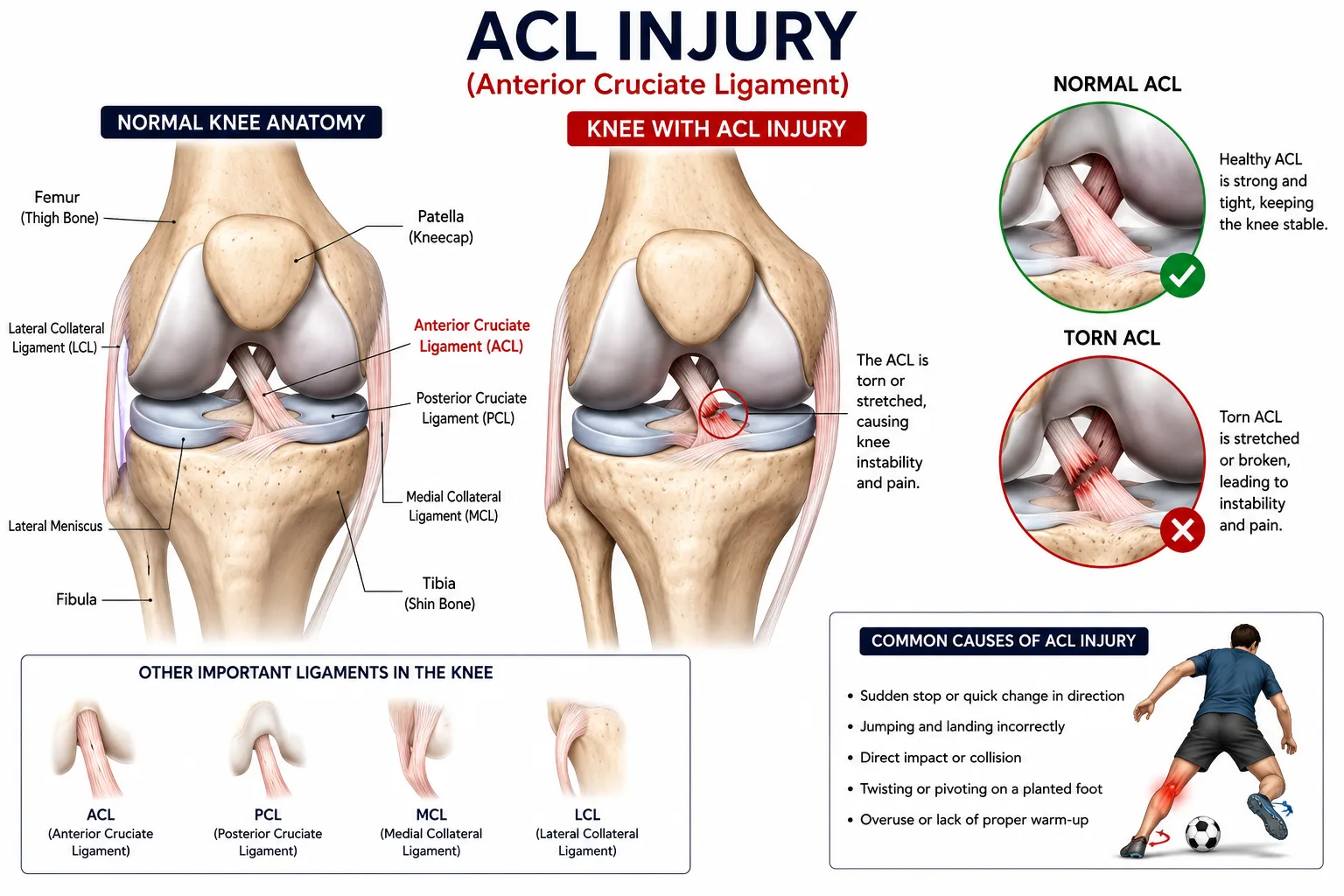
The Anterior Cruciate Ligament (ACL) is one of the four major ligaments of the knee.
It connects the femur to the tibia and contributes to:
- Knee stability
- Control of forward tibial movement
- Rotational control
- Dynamic control during running and sports
An ACL injury can be a partial tear or complete rupture.
ACL injuries can occur during sports such as football, basketball, cricket, badminton, tennis, skiing, and other activities involving rapid changes in direction.
Common Causes of ACL Injury
An ACL injury can occur when the knee is exposed to a sudden force or uncontrolled movement.
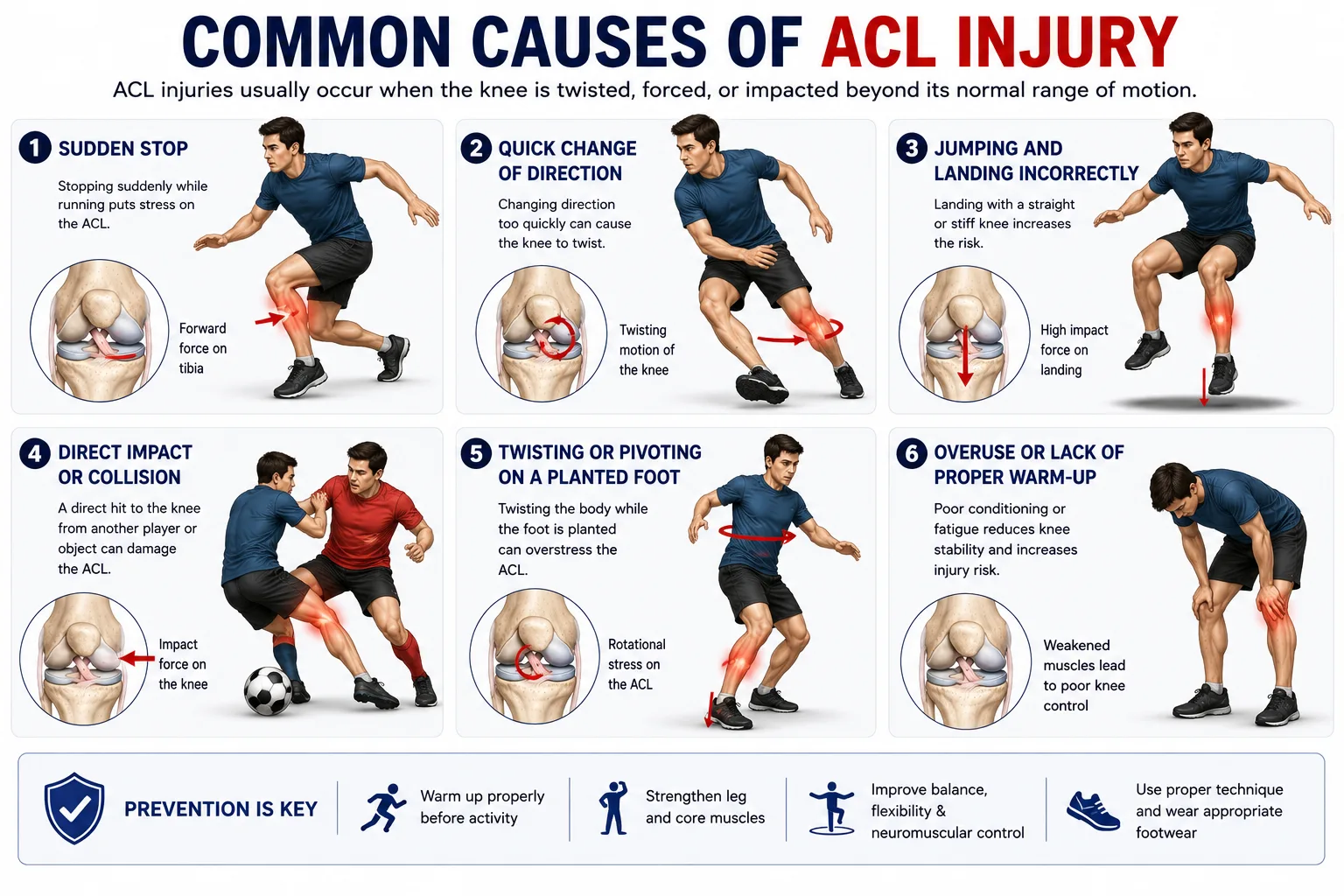
Common mechanisms include:
1. Sudden Change of Direction
Rapid cutting or pivoting while the foot remains planted can place high stress on the ACL.
2. Incorrect Landing
Landing from a jump with poor lower-limb control can increase stress on the knee.
3. Sudden Stopping
Rapid deceleration can create significant forces around the knee.
4. Twisting Injury
The knee may twist while the foot is fixed to the ground.
5. Contact Injury
A direct blow or collision can force the knee into an abnormal position.
Common Signs and Symptoms
An ACL injury may cause:
- A popping sensation or sound
- Sudden knee pain
- Rapid swelling
- Difficulty putting weight through the leg
- Reduced knee movement
- Feeling that the knee is unstable or “giving way”
- Difficulty running, jumping, cutting, or changing direction
These symptoms can also occur with other knee injuries, so a proper clinical assessment is important.
How Is an ACL Injury Diagnosed?
Diagnosis generally begins with a detailed history and physical examination.
A healthcare professional may assess:
- Knee swelling
- Range of motion
- Ligament stability
- Muscle strength
- Walking pattern
- Functional movement
An MRI may be used to confirm an ACL injury and identify associated injuries involving the meniscus, cartilage, or other ligaments. X-rays may also be used when a fracture or other bony injury needs to be assessed.
ACL Injury Treatment Options
Treatment depends on factors such as:
- Severity of the ACL injury
- Knee stability
- Associated meniscus or cartilage injuries
- Age and activity level
- Occupational demands
- Sporting goals
- Patient preferences
Non-Surgical Rehabilitation
Some ACL injuries can be managed with structured rehabilitation without reconstruction.
Rehabilitation focuses on restoring:
- Knee range of motion
- Quadriceps strength
- Hamstring strength
- Hip strength
- Balance and proprioception
- Movement control
- Functional capacity
If the knee continues to give way despite appropriate rehabilitation, further assessment may be required. (NTH NHS Foundation Trust)
ACL Reconstruction
Some people may require ACL reconstruction, particularly when persistent instability or high-demand activities make a stable knee important.
ACL reconstruction replaces the damaged ligament with a graft. Following surgery, rehabilitation is essential for restoring movement, strength, neuromuscular control, and sport-specific function. (OrthoInfo)
ACL Rehabilitation: Step-by-Step
ACL rehabilitation should be individualized and progressed according to clinical milestones, rather than simply following a calendar.
Phase 1: Protection and Swelling Control
Main Goals
- Reduce pain and swelling
- Protect the knee
- Restore comfortable movement
- Achieve full knee extension
- Begin activating the quadriceps
- Establish a safe walking pattern
Early rehabilitation may include appropriate range-of-motion exercises, quadriceps activation, swelling management, and walking assistance when required.
After ACL reconstruction, physiotherapy generally begins early and progresses according to pain, range of motion, muscle strength, and clinical findings. (OrthoInfo)
Phase 2: Restore Range of Motion and Basic Strength
Once pain and swelling are controlled, rehabilitation focuses on restoring normal movement and rebuilding basic muscle strength.
Common rehabilitation components may include:
- Quadriceps strengthening
- Hamstring strengthening
- Hip strengthening
- Calf strengthening
- Controlled squats
- Step exercises
- Stationary cycling when appropriate
- Balance exercises
The exact exercises should be selected according to the patient’s injury, surgery, associated injuries, and current ability.
Phase 3: Strength and Neuromuscular Control
This phase focuses on developing stronger and better-controlled movement.
Important goals include:
Quadriceps Strength
Strong quadriceps are particularly important for knee function after ACL injury and reconstruction. (Cambridge University Hospitals)
Hamstring Strength
The hamstrings contribute to dynamic control of the knee.
Hip Strength
The gluteal and hip muscles help control the position of the hip, knee, and lower limb during functional activities.
Balance and Proprioception
Exercises progress from simple balance tasks to more challenging single-leg activities.
Phase 4: Running, Jumping and Agility
Once adequate strength, movement control, and clinical criteria have been achieved, rehabilitation can progress toward higher-level activities.
These may include:
- Jogging
- Running
- Hopping
- Jumping
- Landing drills
- Acceleration
- Deceleration
- Change-of-direction drills
- Agility exercises
Progression should be guided by the physiotherapist or rehabilitation professional rather than based only on the number of weeks since injury or surgery. (Cambridge University Hospitals)
Phase 5: Sport-Specific Rehabilitation
For athletes, rehabilitation should eventually reproduce the demands of their particular sport.
For example:
Football/Cricket
- Sprinting
- Cutting
- Deceleration
- Direction changes
- Jumping and landing
Basketball
- Repeated jumping
- Landing control
- Cutting
- Acceleration and deceleration
Tennis/Badminton
- Lateral movement
- Rapid stopping
- Direction changes
- Single-leg control
The goal is not simply to make the knee feel better. The goal is to develop the strength, control, confidence, and physical capacity required for the person’s activity.
When Can You Return to Sport After ACL Injury?
There is no single recovery time that is appropriate for everyone.
After ACL reconstruction, return to sport may take many months, and some guidance recommends around 9–12 months or longer, depending on the sport and whether the athlete has achieved appropriate rehabilitation goals. (nhs.uk)
More importantly, return to sport should be based on functional and clinical criteria, not just time.
Important considerations may include:
- Full or near-full knee range of motion
- Minimal or no swelling
- Good quadriceps and hamstring strength
- Good single-leg control
- Appropriate hop-test performance
- Good balance and neuromuscular control
- Ability to perform sport-specific movements
- No episodes of knee giving way
- Psychological readiness and confidence
Some rehabilitation guidelines use a strength difference of less than approximately 10% between the injured and uninjured limbs as one component of return-to-sport assessment, alongside other functional tests. (Cambridge University Hospitals)
Why Physiotherapy Is Important After ACL Injury
ACL rehabilitation is more than simply strengthening the knee.
A comprehensive programme may address:
Mobility → Strength → Balance → Neuromuscular Control → Running → Agility → Sport-Specific Training → Return to Sport
Physiotherapy can help monitor progress and modify exercises as the knee becomes stronger and more capable.
After surgery, rehabilitation is particularly important for regaining knee movement and strength and progressing toward normal activities. (nhs.uk)
Can an ACL Injury Be Prevented?
ACL injury-prevention programmes commonly focus on:
- Proper warm-up
- Strength training
- Landing technique
- Balance and proprioception
- Neuromuscular control
- Jumping and landing mechanics
- Agility training
These programmes are particularly useful for athletes involved in sports requiring jumping, cutting and rapid changes of direction. (The Rotherham NHS Foundation Trust)
When Should You See a Physiotherapist or Orthopaedic Specialist?
You should seek professional assessment if you experience:
- Sudden knee swelling after an injury
- A popping sensation during injury
- Repeated knee giving way
- Difficulty bearing weight
- Significant loss of knee movement
- Persistent pain or swelling
- Difficulty returning to sport or normal activities
An assessment can help determine whether the problem involves the ACL, meniscus, cartilage, other ligaments, or another knee structure.